Showing posts with label Congas for Christ. Show all posts

Monday, July 22, 2013

"Time for the Table" The Way and Means

"Time for the Table"

The Way and Means


1. The basics. What every musician or instrumentalist needs to know about, reading and counting time in music:


Counting (2)

2. The lessons. Twelve lessons:


3. Prayer and practice aids:


Sunday, July 21, 2013

Time for the Table

Writing the Foreword to the YOUCAT (2011), the Catholic Church's condensed catechism on Church teaching written especially for youth, Pope Benedict XVI challenges his young friends: "Today I recommend for your reading an unusual book.  It is unusual both because of its content and because of the way it came to be.  I would like to tell you a little about how it was written, because then it will be clear why it is so unusual."  

Our Pope explains, in a nutshell, after Vatican II (an official meeting of the Catholic Church in Rome lasting from 1962-1965) and a changing culture, many people in society and the Church were left confused. 

What's a Christian to believe?  Can we believe anything the Church teaches, is it even reasonable to be a believer?  Then came the bold and decisive decision of Pope John Paul II to write a book that would answer these questions.  "...a real book, " writes Pope Benedict XVI, "not just a haphazard collection of all sorts of documents…..something entirely new and exciting…..It would show what the Catholic Church believes today and how one can with good reason believe." 

In December 2009, during the spring time of my own reversion, having been plodding along all these years, sort of lost in an agnostic, moral relativism, making room at times for a non-denominational New-Age way of thinking, I had now found a sudden spark of light in, who would have guessed, that traditional 'old fashioned' Catholicism of my youth.  I bought a used version (the Pope's vision having already manifested into reality nearly 15 years before) with the 'old-fashioned' title: Catechism of the Catholic Church (1994) and proceeded to read it cover to cover. 

Wow, I was floored and blown away even though much of it was way to deep, theologically and philosophically.  I had received nothing at all like this before.  Well at least now I could partly understand the underlying causes of my departure from the Catholic Church. 

IGNORANCE.   There, swallowing my pride, I have spoken the truth.  Now since I have publicly admitted it - how about you?  What do you REALLY know about the CHURCH, your faith?  What is your hope grounded in?  Superstition?  The world?

Having been born in 1964, I had been poorly "formed" in the Church during the 30 year period prior to 1994 where, even today, the Church admits its existence was punctuated by a drought of religious education, a catechetical vacuum of sorts.

Now here's some great news.  Motivated by the success and enthusiasm of the World Youth Days started during the pontificate of John Paul II,  "- young people from all over the world have come together, young people who want to believe, who are seeking God, who love Christ, and who want fellowship on their journey."  - Pope Benedict VXI

Seventeen years from its original 1994 publishing date, the Catechism of the Catholic Church has been translated into the much more approachable and fascinating version called YOUCAT.   This little yellow paperback book with mostly cartoon stick figure illustrations scattered throughout it's pages is fun; see for yourself.

Pope Benedict XVI (now our Pope Emeritus) continues his Foreword with a fervent challenge: "Study this Catechism!  That is my heartfelt desire.  This Catechism was not written to please you.  It will not make life easy for you, because it demands of you a new life.  It places before you the Gospel message as the 'pearl of great value' (Mt. 13:46) for which you must give everything.  So I beg you:  Study this Catechism with passion and perseverance.  Make a sacrifice of your time for it!  Study it in the quiet of your room; read it with a friend; form study groups and networks; share with each other on the Internet.  By all means continue to talk with each other about your faith.  You need to know what you believe.  You need to know your faith with that same precision with which an IT specialist knows the inner workings of a computer.    You need to understand it like a good musician knows the piece he is playing." [emphasis is mine]

Bingo!  The principles taught in the YOUCAT make all that follow it better.  So if you're a soccer camp founded on YOUCAT teachings then you're a better soccer team; a choral group founded on YOUCAT teachings then you're a better choral group; a cooking club, a couple of auto mechanics swapping tips, a hunting and fishing group - all better communities when grounded in these truth principals. 

How about Internet based hand percussion lessons, short video segments free of charge, presenting multi-cultural rhythms from around the world along with YOUCAT teachings? Why not.  I think you'd be a better percussion community because of it.

My imagination kicks into gear and I can even envision a parish or similar community level YOUCAT Conga Camp (study group) complete with yellow YOUCAT paperbacks and matching yellow t-shirts: "St. Luke's  YOUCAT Conga Cats"  emblazoned across the front or back; you substitute in the name of your own parish or community group. 

One could easily work in at least one YOUCAT point while facilitating a world rhythm circle or percussion lesson.  How about a YouTube channel for the group to access; Google + page to post the sheet music and Google Hangouts sessions to interact with those community members located across the country or world?

YOUCAT enthusiasts can join international, online groups for fellowship and where pictures and photos of all the fun can be uploaded.   I can see the photo now:  a conga under one arm and a YOUCAT paperback in the other hand.  Call me a romantic, call me a dreamer- no, call me a Christian following the call to a New Evangelization!

Convinced but not yet sure how to integrate your hobby with our new YOUCAT? 

Why not follow me for now with my new "Time for the Table" series where I really stretch out on a limb and try a lot of new, (fortunately very low cost or free) technology.  We'll find out together what works and what can be improved upon. 

 
Saint Mother Theresa [updated 2/4/2017] encourages Christians to be faithful and not to worry about whether or not we are successful in the process; God takes care of that part.   If just a small handful of people follow your work, more than likely friends and family members; great, you've wonderfully succeeded!  Then teach these people how to use these same tools so that a handful of people follow each of them; and so on….

Christianity has changed the world and will continue to do so; we can change the world too.  "Do not be afraid!" exclaims Pope Saint John Paul II [updated 2/4/2017].

Do not be afraid!

Monday, July 8, 2013

Community Drumming 101

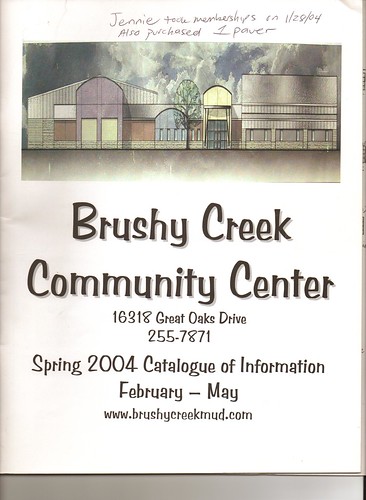
During late 2003, an opportunity to share my love for the conga drums in a paid teaching effort came about by way of the new Brushy Creek Community Center scheduled to open in the spring of 2004 (Round Rock, Texas). 


Community drum lessons by Gary Geraci


About a year after leaving the band Stones Throw in 2000, I had been tinkering around with ways to apply my collection of percussion books, videos, and personal playing experience into "on-the-side" lessons,  in addition to my regular employment, a little business of my own.  

Over the next several years, I developed a lesson plan that in it's advancement paralleled the way one progresses in a karate class through the qualification of colored belts.  In my early twenties, I had personally progressed from a white belt in karate to a green belt, just falling short of obtaining a blue belt after suffering a third degree sprain in my neck.  

To summarize, my entire percussion course would consist of ten colored levels, from gray through maroon; the first level gray being for beginners and the tenth and final maroon level for "seasoned pros;" having of course already studied and practiced the eight color levels in-between and now finding themselves capable and equipped with the skills to perform with percussion instruments during a live show. 

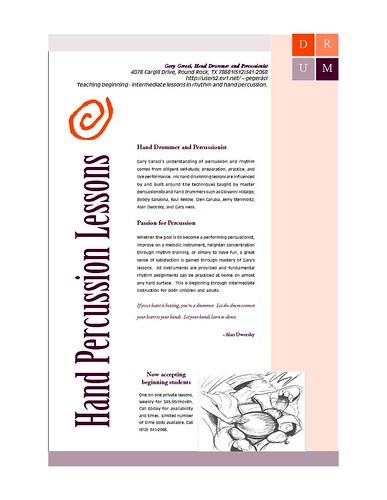
In my zeal I placed ads in the local community newsletter and I stapled flyers on community boards and I waited…...and waited.
percussion lessons flyer
Unfortunately but predictably, despite my best efforts at self promotion, I managed to acquire just one paid student, Sahel, a nice and patient man from Persia.   What a good time we had even though we transacted just about a month's worth of classes.  

When Sahel called me back for more lessons a few months later, I had already given up - I had taken a new job that required me to be on the road several nights a week and so I no longer had the same availability as I had had before but this job would not last much longer; fortunately!

So when  the Brushy Creek Community Center opportunity arrived in 2003 you can probably imagine my enthusiasm going before the Board of Directors and promoting one hour community drumming classes- and finding they were all in -and that they loved it!

I even attended the grand opening event with a table full of instruments and an exciting "looped" video of a community drum circle.  When the full colored, Spring 2004 Grand Opening catalogue was mailed out to all the residents of the Brushy Creek Municipal Utility District (MUD) my class was in it! 


Community drum lessons by Gary Geraci

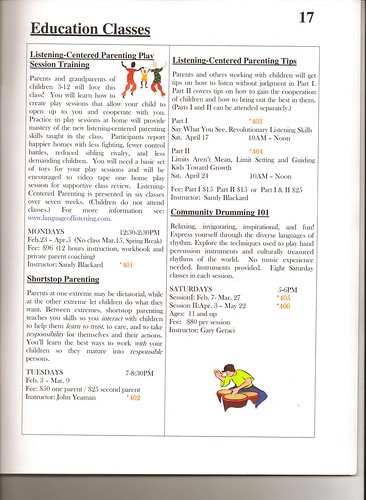
"Community Drumming 101" Saturdays 5-6pm.  Only $80 for all eight Saturdays.  My class was mixed together with classes and workshops and educational offerings in topics ranging from fitness, dancercise, crafts, sewing, stitching, quilts, ceramics, cooking, nutrition, gardening, parenting, art, first-aid, spring-camps & events, tots programs, after school programs, senior activities, etc.;  most of the classes fee based.   However, on-top of the individual class fee there was a hefty annual family membership fee of $300.  

Still, the Center thrives to this day, a wonderful community asset, and so the up-front fees couldn't have been the problem.  Maybe it was the day, Saturdays, or the time slot between 5 and 6 pm?

Despite doing my homework, neither one of my two advertised  8 week sessions drew any interest. I had either overpriced the session, picked a bad time slot, or simply people were not interested in community drumming as an activity.   

When the MUD called me to offer reassurance and to extend the class offering into the fall, I declined explaining I had started my own appraisal practice and would no longer have time to offer the classes.  

And so my great foray into percussion education came to a close.

What is it about music that so excites the soul?  Or sewing?  Or reading?  Or cooking?  Or gardening?  Or computing?  Or playing soccer?  Or any other wholesome hobby for that matter?

I didn't quite see it then but in reality, they are all gifts, God given gifts.   

The joys and advantages one finds say in the varying rhythms and hand patterns, the passion for learning and playing new world rhythms; all are simply graces; graces that have been given FREE of charge. 

The desire to teach and share with others are graces from God too. 

Musical talents in my case, maybe sewing, reading, cooking, gardening, computing, or playing soccer in your case.

Maybe all along, I'd simply taken the wrong approach.

Sunday, March 11, 2012

Drum Machines Don't Have Souls

Loosely based on "The Argument of the Unmoved Mover" by
St. Thomas Aquinas

The first and more manifest way is the argument from motion. 

A skilled drummer, moving her hands over a drum, produces the sounds of organized rhythm.  Who can doubt this or not be moved by it during a night of entertainment?

It is certain, and evident to our senses, that in the world some things are in motion. 

Certainly, we see the hands of this drummer moving in time, 1,2,3,4, while hearing the sound Dum Dum Pa Te Re, Dum Dum Du Pa Ta Te Re emanating from the skin of the drum head and making us want to move.

Now whatever is in motion is put in motion by another, for nothing can be in motion except it is in potentiality to that towards which it is in motion; whereas a thing moves inasmuch as it is in act.

The hands of this drummer, creating the rhythm that moves us while in the audience, were put into motion by the heart and mind of the drummer, from where else?  Ever since the drummer loved this pattern and then learned and practiced the pattern, she's been quite ready to play the pattern, only lacking the opportunity to play it before an audience - that's all.

For motion is nothing else than the reduction of something from potentiality to actuality.

Before then, she was just a woman desiring to play something recognizably cool on some instrument already known to most cultures around the world as a hand drum.  Before then she was just the baby girl in a family who loved to perform music in front of her siblings.    Before then she was conceived in love by her mother and father after a night of dancing at Ricky Ricardo's nightclub.

But nothing can be reduced from potentiality to actuality, except by something in a state of actuality.

But first, it took seeing herself capable of loving, learning, and playing such an instrument.  In most cases, prior to becoming a drummer, one needs:
  • two hands-check, 
  • a belief in ones own sense of rhythm-semi check, 
  • a love of music-check, 
  • vainglory for the adoration of an audience-bold check, and 
  • perhaps even a genetic disposition to perform music-check (she had brothers that were in a band).
Love first, to get her through all of the purchasing of instruments, lesson books, tapes, private lessons, practice and more practice and then the big leap into performing music next. 

Thus that which is actually hot, as fire, makes wood, which is potentially hot, to be actually hot, and thereby moves and changes it.

One day, finally, standing straight before her audience, tapping her foot in time 1, 2, 3, 4, out comes the pattern from her heart and mind, to her hand, to the drum head, Dum Dum Pa Te Re, Dum Dum Du Pa Ta Te Re.

Now, we too feel this love of music, fully evolved in a passionate delivery of rhythm over a hand drum.  Hearing it moves us and the rest of the crowd and we begin to sway and tap our feet to the beat.

Now it is not possible that the same thing should be at once in actuality and potentiality in the same respect, but only in different respects.  For what is actually hot cannot simultaneously be potentially hot; but it is simultaneously potentially cold.

While the drummer is right on the mark with her drumming, those of us in the audience continue to feel this incredible pull to get up and dance, which we all do, but some of us can dance while the rest of us cannot; we are all moved by the beat to try anyway, maybe even someone in the audience will be so inspired now to take up drumming too.

It is therefore impossible that in the same respect and in the same way a thing should be both mover and moved, i.e. that it should move itself. Therefore, whatever is in motion must be put in motion by another.

She sees us dance and is filled with joy, making her want to also dance, but she cannot, as she is the one providing the very beat that we are dancing to. 

If that by which it is put in motion be itself put in motion, then this also must needs be put in motion by another, and that by another again.

Driven by her own music genealogy, mutated forward from the million plus year old primordial soup she originated from, she could try to seamlessly switch on her pre-programmed drum machine, set a drum loop, and leave the bandstand and join us in dance.   As she comes toward us we might envision the programmer of the drum loop having sat in some home studio operating some music software created by some mathematical formula translated into bits and bytes, in some office run by some person who took 4 years of electrical engineering at some college formed by some board of directors, managing the assets of some wealthy donors…..

But this cannot go on to infinity, because then there would be no first mover, and, consequently, no other mover; seeing that subsequent movers move only inasmuch as they are put in motion by the first mover; as the staff moves only because it is put in motion by the hand.

….and precisely conclude drum machines don't have souls and wouldn't move us quite like our human drummer with love in her heart.

Therefore it is necessary to arrive at a first mover, put in motion by no other; and this everyone understands to be God.

Sunday, January 15, 2012

Shed Sessions

A few weeks ago, while listening to the Catholic Business Hour hosted by Dick Lyles, the host mentioned how he had actively conditioned himself over time to react to the sound of a siren while driving.   He simply pulls over now without having to give it any thought.   What used to be a deliberate 'active participation' has now become a conditioned, well rehearsed response.  The siren causes a different reaction when he's in the office and hears it; no response at all, the siren is ignored.

He went on to say, in the same way, one can actively participate in spiritual activities so as to condition oneself against attacks of temptation and other evil persuasions, slight as they might be, unobvious as they might me, often just subtle suggestions.  If you require further evidence or convincing regarding the evil the host is talking about, I suggest that you pick-up a copy of the book "Screwtape Letters" by C.S. Lewis.  

The great deceiver is always at work, often in ways that are not so apparent either.

As Catholics we have great recourse to 'active participation' through Jesus Christ, his church, and the communion of saints:

  1. Daily prayer, spiritual reading, and acts of mortification such as fasting or denying oneself some other creature comfort; that's 'active participation' conditioning oneself against that which separates us from God, namely sin.
  2. Attending a Catholic mass.  Standing, sitting, kneeling, hand motions, bell ringing, reading, listening, tasting, chewing, drinking, singing, praying, greeting others; that's 'active participation' allowing a real, physical manifestation of the Father, Son and Holy Spirit into one's life. 
  3. Reciting a Rosary.  Out loud with a partner or silent and alone, with or without feeling , persevering none-the-less through the 15 to 20 minutes that it takes to complete the prayer; that's 'active participation' creating greater calm, understanding, and hope during difficulties or times of suffering.

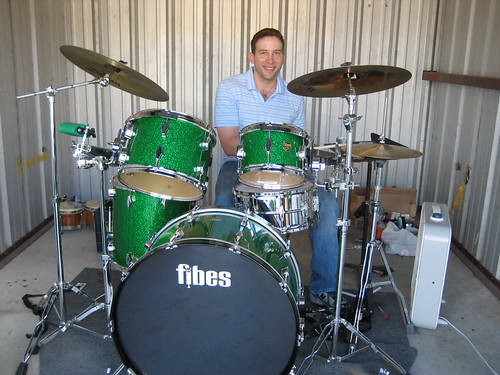
My brother Marc Geraci and I would get together twice a week for a shed session, a jam session in a rented storage unit where we could play music for several hours at a time.  We were perfecting and honing our rhythm and timing skills, trading beats, practicing dynamics (the lowering and raising of our instrument volume), and then going through our set lists and working out our parts.  That's 'active participation' now for the conditioned response of putting on a great, well rehearsed show later on.

The "Shed"

Conditioning ourselves through our own 'active participation' in the one Body of Christ, his church, allows us an effective, tried and true way of conquering our sins now, reversing the damaging habits of vice now, and replacing sin now with acts of virtue and holiness, keeping the evil one and his minions at bay, so that we may more closely unite to the one true God.

Sunday, November 27, 2011

Myanmar Ensemble

"Looking out into the crowd, they too are caught up in this same 'groove' as if we were able to transmit this very 'groove'  to them.   Truly then is the crowd caught up in this joy or its something, because they're all smiling, tapping their feet, or have been liberated enough to come up to the dance floor and start dancing about."

Indian Drum Circle

"The more people present before us the more exciting things got.   But what really did it for us?  It's when we had enough practice together that each of our individual parts melded perfectly with the other so that we all instantaneously shared this joyous anticipation that tonight, perhaps unlike last night, we were 'in a groove' and we were 'feeling it'..."

Peace Drum Circles

"Entertaining the people - our fans, spreading joy, freedom, liberation via our ability to perform music in communion with one another, our commitment to be a show for one another, for the crowd..."


Wednesday, November 16, 2011

Charpentier Te deum (1)

Te Deum Laudamus! "O God, we praise thee!" A rousing Timpani part keeps this piece going.......


Sunday, October 23, 2011

Vespro della Beata Vergine

Mother Mary makes her entry at the precise moment the vocalist begins, her long white flowing dress trails far away into the distance, supported by the wings of hundreds of seraphim. She walks into the great hall and gazes first at her Son and then at you - oh so radiant, pure and full of love!


Saturday, October 22, 2011

Congas for Christ!

Day by day and for the first time in my life, I get a bit further in my personal reading of the Old Testament section of the Holy Bible (Catholic).   I'm in 1 Chronicles 25:1 right now.  It's elating for me to think that Mary, our great Jewish Mother and the Mother of Jesus Christ, was so dedicated in her own personal study and fidelity to God, to the teachings of Jewish Scriptures.

A musician most of my life, I am struck by how many times I see the word "cymbals" and other words referencing musical instruments, but especially "cymbals."  

This morning, wanting to see perhaps how many times the word "cymbals" is used in the Bible, I did a Google search and I came across the following blog post instead:  

God Loves to Reveal Himself Through Music  by Dave Cover 

It's worth the read, especially to anyone who sings or plays music or perhaps is thinking about playing music or singing in the future. 

I think this biblical/historical tie speaks volumes for the power of rhythm and music in persevering to unite people in love and celebration all over the world; activities that glorify God -  -music made in praise, worship, celebration, and best of all, LOVE!

Here's what my own church, the Catholic Church teaches about the subject of music in her Catechism of the Catholic Church (CCC)- Part Two, The Celebration of the Christian Mystery,( …..anyone with a new YouCat? Please comment if music is referenced here.)

  1. importance of songs and music (CCC 1158)
  1. liturgical music as Church's treasure (CCC 1156)
  1. Sign function in the liturgy (CCC 1157)

Sadly, like wealth, art, food, and fashion, rhythm and music can also be used for the profanation of man.  I've seen it used to incite rebellion and instigate overt sensuality and I have seen it performed preceding horrible acts of genocide and war. 

For my part, I would like to join the focus on using rhythm and music for the love of neighbor and community, celebration, increasing virtue while decreasing vice; i.e. playing rhythm and music to glorify God! 

So, from time to time, I will try to give you or point you to a few simple rhythms here; like the Tumbao.  These rhythms originate from all over the world.  Play them alone or in community with your family and friends.  Practice them throughout the day perhaps preceding meditation or prayer.  Whether you have an instrument or not, play these rhythms on a table top, in union with your own community or in union with the saints, the Old Covenant cymbal players, most of all, play these rhythms for the glory of God! 


Sunday, May 22, 2011

Candido Camero - "MANTECA"

One of my all time favorite conga performances; I watch this one over and over again for inspiration. Enjoy and don't let age stop you from picking up a drum!